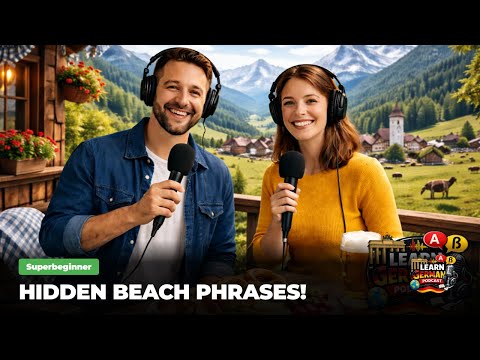
Includes greetings like 'Guten Morgen', polite requests, café ordering phrases, Du vs Sie etiquette, and common shop replies—Julia and Tim role-play practical everyday exchanges.
Weißt du, was viele Lernende falsch machen? Sie denken, ein Wort reicht immer. Aber im Deutschen hat zum Beispiel "bitte" gleich drei Bedeutungen. Das verwirrt total, oder? Do you know what many learners get wrong? They think one word is always enough. But in German, for example, "bitte" has three meanings. That can be really confusing, right?
Ja, und ganz ehrlich, das größte Fettnäpfchen ist oft "du" und "Sie". Viele sagen einfach "du" im Laden und das wirkt dann ein bisschen unhöflich. Kennst du das auch?
Yes, and honestly, the biggest pitfall is often "du" and "Sie". Many just say "du" in stores and it can come off as a bit rude. Do you find that too?
Okay, bevor wir reinstarten, hallo zusammen, schön, dass ihr dabei seid. Wir sprechen heute über wichtige Sätze für den Alltag. Also, Sachen, die ihr wirklich jeden Tag braucht.
Okay, before we dive in, hello everyone, great to have you here. Today we're talking about important sentences for everyday life. So, things you'll really need every day.
Hi ihr Lieben! Holt euch einen Kaffee, wir machen das locker und praktisch. Und ja, wir üben direkt mit kleinen Dialogen, damit ihr's gleich nutzen könnt.
Hi everyone! Grab a coffee, we’ll keep it casual and practical. And yes, we'll practice right away with small dialogues so you can use them immediately.
Genau! Wir sammeln heute so 10 bis 15 Sätze, die euch überall helfen. Im Café, auf der Straße, im Supermarkt. Und wir schauen kurz auf Aussprache und diese "Du-Sie"-Sache.
Exactly! Today we're collecting about 10 to 15 sentences that will help you everywhere. In the café, on the street, in the supermarket. And we'll briefly touch on pronunciation and the "Du-Sie" thing.
Starten wir mit dem ersten Block, Begrüßung und kleines Gespräch. Also, guten Morgen, guten Tag, guten Abend. Und dann oft: "Wie geht's?" Oder formell: "Wie geht es Ihnen?"
Let's start with the first block, greetings and small talk. So, good morning, good day, good evening. And often: "How are you?" Or formally: "How do you do?"
Ja, und die Antwort geht super einfach. "Gut, danke, und dir?" Oder formell: "Und Ihnen?" Wenn's nicht so gut ist, "es geht so" oder "nicht so gut heute".
Yes, and the response is really simple. "Good, thanks, and you?" Or formally: "And you?" If it’s not going so well, "I’m okay" or "not so good today."
Und sehr wichtig: "Entschuldigung" zum Ansprechen. Also, wenn ihr jemanden höflich stoppen wollt. Oder wenn ihr aus Versehen anstoßt, dann: "Oh, Entschuldigung" oder "Tut mir leid." And very importantly: "Excuse me" for getting someone's attention. So, if you want to politely stop someone. Or if you accidentally bump into someone, then: "Oh, excuse me" or "I'm sorry."
Machen wir direkt ein kurzes Rollenspiel, okay? Situation: Bäckerei. Ich bin Kunde, du bist die Verkäuferin.
Let’s do a quick role play, okay? Situation: Bakery. I'm the customer, you’re the seller.
Alles klar. Guten Morgen. Was darf's sein?
All right. Good morning. What can I get for you?
Guten Morgen. Ich hätte gern zwei Brötchen und ein Croissant, bitte. Und, äh, haben Sie auch Vollkornbrot? Good morning. I’d like two rolls and a croissant, please. And, uh, do you have whole grain bread as well?
Ja, haben wir. Möchten Sie eine Tüte?
Yes, we do. Would you like a bag?
Ja, bitte, eine kleine Tüte. Das wär's dann, danke. Yes, please, a small bag. That would be all, thank you.
Macht 3,50 Euro. Zahlen Sie bar oder mit Karte?
That’s 3.50 euros. Will you be paying cash or by card?
Mit Karte, bitte. Dankeschön. By card, please. Thank you.
Gern geschehen. Schönen Tag noch.
You’re welcome. Have a nice day.
So, da steckten schon viele gute Sätze drin. "Ich hätte gern." "Haben Sie?" "Möchten Sie eine Tüte?" "Das wär's." "Mit Karte, bitte." So, there were already many good sentences in there. "I’d like." "Do you have?" "Would you like a bag?" "That would be all." "By card, please."
Das sind echte Alltagsstars.
Those are real everyday stars.
Mittagsstars. Und kleiner Hinweis: Sagt bitte lieber "ich hätte gern" als "ich will". Lunch stars. And a little note: Please say "I’d like" instead of "I want."
"Ich will" klingt schnell zu direkt. "Ich nehme" ist auch okay und freundlich.
"I want" can sound too direct. "I’ll take" is also okay and friendly.
Kurz zu "du" und "Sie". In Geschäften sagt man fast immer "Sie".
Briefly about "du" and "Sie". In shops, you almost always say "Sie".
Also, äh, "haben Sie?" "Könnten Sie?" Mit Freunden ist es dann, äh, "du, hast du?" Ganz easy, aber wichtig.
So, uh, "do you have?" "Could you?" With friends, it’s then, uh, "you, do you have?" Super easy, but important.
Aussprache.
Pronunciation.
Viele kämpfen mit "ü", zum Beispiel in "Tüte".
Many struggle with "ü", for example in "Tüte".
Stell den Mund wie für "u", aber sag dabei "i".
Position your mouth as if for "u", but say "i".
So kommt "ü".
That’s how you get "ü".
Wenn ihr etwas nicht versteht, nehmt diese Sätze: "Wie bitte?", "Könnten Sie das bitte wiederholen?", "Langsamer bitte." If you don’t understand something, use these phrases: "Pardon?", "Could you repeat that, please?", "Slower, please."
Das rettet euch so oft, echt jetzt.
It’ll save you so often, really.
Und beim Bezahlen: "Was kostet das?" Oder "Wie viel kostet das?" Das ist klar und höflich.
And when paying: "What does that cost?" Or "How much is that?" That’s clear and polite.
Alternativ geht auch: "Entschuldigung, was kostet der Kaffee?" Alternatively, you can say: "Excuse me, how much does the coffee cost?"
Übrigens, ein klassischer Fehler.
By the way, a classic mistake.
Jemand wollte mal ein Geschenk kaufen und hat "Gift" gesagt. Someone once wanted to buy a gift and said "Gift."
"Gift" ist auf Deutsch aber "Poison".
"Gift" in German means "poison."
Uff, peinlich, aber man merkt es sich dann für immer.
Oof, embarrassing, but it sticks with you forever.
Ja, seitdem sage ich immer deutlich "Geschenk". Yes, since then I always say clearly "Geschenk."
Und man kann sogar sagen: "Das ist ein Geschenk für meine Freundin." Das ist eine nette kleine Alltagsformulierung. And you can even say: "That’s a gift for my girlfriend." That’s a nice little everyday expression.
Kurzer Check in der Mitte.
Quick check in the middle.
Miniquiz: Was bedeutet "ich hätte gern einen Kaffee, bitte"? Mini quiz: What does "I’d like a coffee, please" mean?
Genau. Das ist eine höfliche Bestellung, nicht zu direkt.
Exactly. That’s a polite order, not too direct.
Und zweite Frage: Wann benutzt du "Sie"?
And second question: When do you use "Sie"?
Antwort: "Sie" benutzt du bei fremden Menschen, im Laden, im Amt, bei der Arbeit mit neuen Kollegen.
Answer: You use "Sie" with strangers, in the store, in an office, when working with new colleagues.
"Du" ist für Freunde, Familie, Kollegen, wenn ihr euch darauf geeinigt habt.
"Du" is for friends, family, colleagues, if you’ve agreed on that.
Easy, oder?
Easy, right?
Gehen wir weiter, Richtung Fragen.
Let’s move on, towards questions.
Super nützlich sind: "Entschuldigung, ich suche", "Wo ist?" und "Wie komme ich zum?" Super useful are: "Excuse me, I’m looking for," "Where is?" and "How do I get to?"
Plus die Wörter "links", "rechts", "geradeaus".
Plus the words "left," "right," "straight ahead."
Machen wir ein zweites Rollenspiel.
Let’s do a second role play.
Ich bin Besucherin, du kennst die Stadt.
I'm a visitor, you know the city.
Entschuldigung, wo ist bitte die U-Bahn? Excuse me, where is the subway, please?
Also, geradeaus, dann links an der Ampel, an der Ecke neben der Apotheke.
So, straight ahead, then left at the traffic light, at the corner next to the pharmacy.
Super, danke schön. Sie haben mir sehr geholfen.
Great, thank you very much. You've really helped me.
Gern. Und wenn die Erklärung zu schnell ist, sagt einfach: "Könnten Sie das bitte nochmal langsam sagen?" Sure. And if the explanation is too fast, just say, "Could you please say that again slowly?"
Oder: "Könnten Sie das aufschreiben?" Das klappt oft wirklich gut.
Or: "Could you write that down?" That often works really well.
An der Kasse hört ihr oft: "Möchten Sie eine Tüte?"
At the checkout, you often hear: "Would you like a bag?"
Für Begegnungen im Haus oder Büro finde ich schön: "Schönen Tag noch", "Schönes Wochenende" oder "Bis später."
For encounters in the house or office, I find nice to say: "Have a nice day," "Have a great weekend," or "See you later."
Wenn ihr zustimmen wollt: "Ja, genau", "Stimmt", "Auf jeden Fall."
If you want to agree: "Yes, exactly," "That's right," "Definitely."
Und vorsichtig widersprechen: "Ich bin nicht sicher", "Ich glaube, das passt nicht", "Vielleicht anders?"
And to disagree gently: "I'm not sure," "I don't think that's right," "Maybe differently?"
Das hält den Ton freundlich.
That keeps the tone friendly.
Ja, weich formulieren ist super.
Yes, soft wording is great.
Statt "Das ist falsch": lieber "Ich glaube, das ist nicht ganz richtig."
Instead of "That's wrong": better to say "I don't think that's quite right."
Oder: "Können wir das anders machen?" Das klingt nett und professionell.
Or: "Can we do that differently?" That sounds nice and professional.
Helfen und Hilfe annehmen sind auch Alltag.
Offering help and accepting help is also part of everyday life.
"Soll ich helfen?" Oder: "Brauchst du Hilfe?"
"Should I help?" Or: "Do you need help?"
Und wenn dir jemand hilft: "Vielen Dank."
And when someone helps you: "Thank you very much."
Antwort: "Gern geschehen" oder "Kein Problem."
Reply: "You're welcome" or "No problem."
Und wenn ihr Hilfe braucht: informell "Kannst du mir kurz helfen?", formell "Könnten Sie mir bitte helfen?" Mit einem kleinen "Bitte" ist das sofort höflich. And if you need help: informally "Can you help me for a moment?", formally "Could you please help me?" A little "please" makes it immediately polite.
Termine abmachen.
Making appointments.
Passt ihr morgen um 9 Uhr?
Does 9 o'clock work for you tomorrow?
Oder formell: "Passt es Ihnen morgen um 9 Uhr?"
Or formally: "Would it be convenient for you tomorrow at 9 o'clock?"
Wenn es später sein soll, geht auch halb drei, also 14:30 Uhr.
If it needs to be later, 2:30 PM works too.
Absagen ohne Stress: "Es tut mir leid, ich schaffe es heute nicht." Oder: "Können wir den Termin verschieben?" Und dann ein Vorschlag: "Vielleicht morgen?" Das ist klar und freundlich.
Canceling without stress: "I'm sorry, I can't make it today." Or: "Can we reschedule?" And then a suggestion: "Maybe tomorrow?" That's clear and friendly.
Kurzer Lerntipp, weil es echt hilft: Kinderbücher.
A quick learning tip, because it really helps: children's books.
Die Sätze sind kurz, die Geschichten machen Spaß.
The sentences are short, the stories are fun.
Du lernst einfache Dialoge, genau das, was du brauchst.
You learn simple dialogues, exactly what you need.
Und hört deutsche Musik oder Podcasts.
And listen to German music or podcasts.
Ich habe mit deutschem Hip-Hop total viele Redewendungen aufgeschnappt.
I picked up a lot of phrases from German hip-hop.
Man kriegt Rhythmus und Betonung, das bleibt im Kopf.
You get rhythm and emphasis, it sticks in your mind.
Zum Üben: Such dir drei Sätze pro Tag und sprich sie laut.
For practice: pick three sentences a day and say them out loud.
Zum Beispiel: "Entschuldigung, können Sie mir helfen?" For example: "Excuse me, can you help me?"
"Ich hätte gern, wie viel kostet das?"
"I would like, how much does that cost?"
Das wiederholt man einfach überall.
Just repeat it everywhere.
Kleines Shadowing hilft auch: Hör einen kurzen Satz und sprich ihn direkt nach.
A little shadowing helps too: listen to a short sentence and repeat it right away.
Achte auf Betonung und Tempo.
Pay attention to emphasis and pace.
So klingt es schnell natürlicher.
This way it sounds more natural quickly.
Ein häufiger Fehler: zu direkt bestellen.
A common mistake: ordering too directly.
Nicht: "Gib mir Wasser", sondern: "Ein Wasser, bitte" oder "Könnte ich ein Wasser bekommen?" Not: "Give me water," but: "A water, please" or "Could I have a water?"
Das ist derselbe Inhalt, nur höflicher.
It's the same content, just more polite.
Und übrigens, viele sagen ständig "sorry".
And by the way, many people continuously say "sorry."
Im Deutschen ist besser: "Entschuldigung" oder "Tut mir leid." In German, it's better: "Entschuldigung" or "Tut mir leid."
Das wirkt gleich respektvoller, besonders bei Fremden.
That sounds much more respectful, especially with strangers.
Für Telefonate reichen ein paar Bausteine.
For phone calls, a few building blocks are enough.
"Hallo, hier ist Tim."
"Hello, this is Tim."
"Ich rufe wegen des Termins an."
"I'm calling about the appointment."
"Könnten Sie das bitte wiederholen?" "Could you please repeat that?"
Wenn die Verbindung schlecht ist: "Ich höre Sie schlecht."
If the connection is bad: "I can hardly hear you."
Und wenn niemand drangeht: "Ich rufe später zurück."
And if no one answers: "I'll call back later."
Oder: "Könnten Sie mich zurückrufen?"
Or: "Could you call me back?"
Ganz einfach und sehr nützlich im Alltag.
Really simple and very useful in everyday life.
Unterwegs, im Bus oder Zug: "Ist hier noch frei?" oder "Ist der Platz frei?"
On the go, in the bus or train: "Is this seat free?" or "Is the place free?"
Beim Einsteigen: "Darf ich mal kurz vorbei?"
When getting on: "Excuse me, may I pass by for a moment?"
Das ist höflich und klappt immer.
That's polite and always works.
Im Restaurant sind drei Sätze Gold.
In restaurants, three phrases are golden.
"Könnten wir bitte bestellen?" "Could we please order?"
"Noch ein Wasser, bitte." Und: "Zahlen, bitte." "Another water, please." And: "The check, please."
Und die Frage kommt oft: "Zusammen oder getrennt?"
And the question often comes: "Together or separate?"
Then: "Separate, please."
Ich fasse mal die Top-Phrasen kurz zusammen.
I'll briefly summarize the top phrases.
Begrüßen, höflich bestellen: "Ich hätte gern."
Greeting, politely ordering: "I'd like."
Nach dem Preis fragen: "Um Hilfe bitten: könnten Sie?"
Asking for the price: "Asking for help: could you?"
Richtungen fragen: "Wo ist?"
Asking for directions: "Where is?"
Und nett verabschieden: "Schönen Tag noch."
And saying goodbye nicely: "Have a nice day."
Ja, und dazu die kleinen Retter.
Yes, and then the little lifesavers.
"Wie bitte?", "Langsamer, bitte." "Das war's, danke." "Kein Problem." "Gern geschehen." "Pardon?", "Slower, please." "That's it, thanks." "No problem." "You're welcome."
Wenn ihr die sicher habt, läuft der Alltag viel entspannter.
If you've got those, daily life runs much smoother.
Jetzt zu euch.
Now it's your turn.
Welche Alltagsphrase benutzt ihr am meisten?
Which everyday phrase do you use the most?
Oder hattet ihr auch mal so einen peinlichen Moment wie mit
Or have you ever had an embarrassing moment like
"Gift" instead of "present"?
Schreibt's uns gern in die Kommentare.
Feel free to share it in the comments.
Okay, das war's für heute.
Okay, that's it for today.
Wenn euch das geholfen hat, lasst doch gern ein Like da und abonniert den Kanal.
If this helped you, please leave a like and subscribe to the channel.
So verpasst ihr die nächsten Mini-Rollenspiele nicht.
That way, you won't miss the next mini-roleplays.
Danke fürs Zuhören und bis bald.
Thanks for listening, and see you soon.