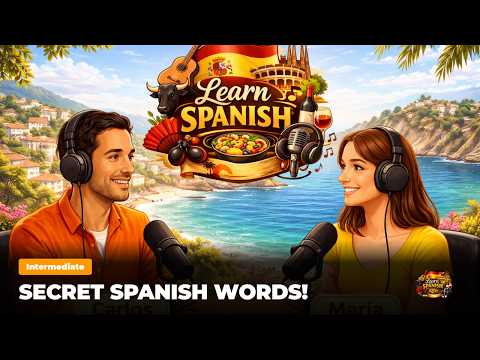
Carlos y María guide 10-minute daily Spanish drills with slow, clear speech. Practice repeatable phrases for ordering food, asking questions, and sending quick messages.
¿Y si te digo que con solo 10 minutos al día puedes sonar mucho más natural en español?
What if I told you that just 10 minutes a day can help you sound much more natural in Spanish?
Hoy vas a aprender una rutina clara, paso a paso, para hablar en situaciones reales,
Today you’re going to learn a clear routine, step by step, for speaking in real situations,
como pedir en un café y mandar un mensaje corto.
like ordering in a café and sending a short message.
Todo pensado para nivel A2, sin cosas raras, directo y útil.
Everything is designed for A2 level, no weird stuff, straight to the point and useful.
Sí, sí, hoy vas a salir con frases listas, pequeños ejercicios y trucos para no traducir palabra por palabra.
Yes, yes, today you’ll walk away with ready phrases, small exercises, and tricks to avoid translating word for word.
También vamos a evitar dos errores muy comunes, el género de las palabras y esas frases que suenan como del diccionario, ¿sabes?
We’re also going to avoid two very common mistakes, the gender of words and those phrases that sound like they’re from a dictionary, you know?
Lo aplicas desde hoy, en la vida real.
You’ll apply it from today, in real life.
Hola, soy Carlos, y me encanta este tema porque, bueno, a mí los mini entrenamientos me salvan el día.
Hi, I’m Carlos, and I love this topic because, well, mini training sessions save my day.
María, ¿cómo vas?
María, how’s it going?
Yo tengo café y mucha energía para estos 10 minutos.
I’ve got coffee and lots of energy for these 10 minutes.
Si quieres practicarlo después, la lección completa está en Vocabli.
If you want to practice later, the complete lesson is on Vocabli.
Vale, entremos ya, la idea es una rutina corta, constante y, o sea, muy práctica.
Alright, let’s get started; the idea is a short, consistent, and very practical routine.
10 minutos, nada más, sin excusas.
10 minutes, nothing more, no excuses.
Propongo esta estructura simple: 2 minutos de calentamiento, 3 minutos de hablar en voz alta con una frase modelo,
I propose this simple structure: 2 minutes of warming up, 3 minutes of speaking out loud with a model sentence,
2 minutos de una pequeña situación real, 2 minutos de repaso de género y pronunciación,
2 minutes of a small real situation, 2 minutes of review on gender and pronunciation,
y un minuto final para grabarte.
and one final minute to record yourself.
Es como un circuito, ¿no?
It’s like a circuit, right?
Sencillo y repetible.
Simple and repeatable.
Empezamos con el calentamiento de 2 minutos, respiras, mueves la boca un poco y dices frases fáciles.
We start with the 2-minute warm-up, breathe, move your mouth a bit, and say easy phrases.
Por ejemplo, hola, ¿qué tal?
For example, hi, how’s it going?
Perdona, ¿tienes un minuto?
Excuse me, do you have a minute?
Me ayudas con esto 3 veces cada una.
Help me with this 3 times each.
Así el cerebro entra en modo español.
That way, your brain gets into Spanish mode.
Luego vienen los 3 minutos de hablar en voz alta, tipo imitación.
Then comes the 3 minutes of speaking out loud, like imitation.
Coges una frase útil y la repites con emoción.
Take a useful sentence and repeat it with emotion.
Por ejemplo, me pones un café con leche, por favor.
For example, could you get me a coffee with milk, please?
Cambias un detalle cada vez: con azúcar, sin azúcar, para llevar.
Change one detail each time: with sugar, without sugar, to go.
Y ojo con el género desde el principio: el café, la leche, la cuenta.
And watch out for gender from the start: the coffee, the milk, the bill.
Dilo junto: el café, la leche, la cuenta 3 veces.
Say it together: the coffee, the milk, the bill 3 times.
Parece tonto, pero tu boca aprende el ritmo correcto.
It seems silly, but your mouth learns the correct rhythm.
Vale, y ahora hacemos la mini situación real, que es nuestro papelito de hoy.
Okay, and now we do the mini real situation, which is our little role today.
Vamos a hacer un roleplay rápido de café, ¿sí?
Let’s do a quick café roleplay, shall we?
Yo soy el camarero y tú, María, eres la clienta.
I’ll be the waiter and you, María, will be the customer.
Perfecto, vamos.
Perfect, let’s go.
Entro y digo, hola, buenas, ¿me pone un café con leche, por favor?
I enter and say, hi, good day, could I please have a coffee with milk?
Y así, claro.
And there, of course.
Claro, ¿lo quiere para aquí o para llevar?
Sure, do you want it here or to go?
Así, tranquilo.
Nice and calm.
Y miro como esperando, ¿no?
And I look like I'm waiting, right?
Para llevar, por favor.
To go, please.
Im, ¿me pone también una botella de agua?
Um, could I also have a bottle of water?
Aquí digo el agua, pero recuerdo que es femenino, aunque digo el agua por sonido, sí.
Here I say 'the water', but I remember it’s feminine, although I say 'the water' for pronunciation, yes.
Son 2.50, ¿algo más?
That’ll be 2.50, anything else?
Y ya cierro la comanda.
And I close the order.
No, gracias.
No, thank you.
¿Me da la cuenta, por favor?
Could you give me the bill, please?
Y ya pago con una sonrisa.
And then I pay with a smile.
Cosas clave aquí: me pone, o me pones, si hay confianza.
Key things here: I want, or you want me to, if there's trust.
Para llevar es muy útil.
To-go is very useful.
Y ojo: el café, la leche, la cuenta, el agua, pero es femenino, digo el agua fría y luego esta agua.
And note: coffee, milk, the bill, water, but it's feminine, I mean cold water and then this water.
Es un pequeño truco del sonido.
It's a little trick of sound.
Y si te bloqueas, no traduzcas en tu cabeza.
And if you get stuck, don't translate in your head.
No pienses, yujibeme; mejor copia la forma nativa, me pone.
Don't think, just imitate; better to copy the native form, I want.
Es más fácil si repites la frase completa, sin analizar demasiado.
It's easier if you repeat the whole phrase, without over-analyzing.
Segundo consejo práctico: guarda tres frases modelo en notas del móvil.
Second practical tip: save three model phrases in your phone notes.
Hoy pueden ser: me pone un café con leche, lo puedo pagar con tarjeta, y ¿tienen algo sin gluten?
Today they can be: I want a coffee with milk, I can pay by card, and do you have anything gluten-free?
Repite esas tres durante los tres minutos de imitación.
Repeat those three during the three minutes of imitation.
Y si un día no puedes ir al café, haces la misma práctica en casa, en voz alta, mirando una taza.
And if one day you can't go to the café, do the same practice at home, out loud, looking at a cup.
Suena un poco loco, pero funciona.
Sounds a bit crazy, but it works.
Lo importante es la boca en movimiento, ¿vale?
The important thing is the mouth in motion, okay?
Ahora, un minuto de historia real para motivar.
Now, a minute of real history to motivate.
Una persona nos contó que pidió pollo asado con clavos.
Someone told us they ordered roasted chicken with nails.
Quería decir con clavo, la especia, el clavo de olor, pero dijo clavos, como los de la pared.
They meant with clove, the spice, the clove spice, but said nails, like the ones in the wall.
El camarero se rió, con cariño, claro, y todo quedó en anécdota.
The waiter laughed, kindly of course, and it all became an anecdote.
Si esa historia nos recuerda algo, en tus drills practica el bloque entero.
If that story reminds us of something, practice the whole block in your drills.
Mejor: pollo asado con clavo de olor, o si dudas, pollo asado con especias.
Better: roasted chicken with clove, or if in doubt, roasted chicken with spices.
En A2, claridad antes que poesía, ¿sabes?
In A2, clarity over poetry, you know?
Volvemos a la rutina.
Let's get back to the routine.
En el minuto 5 al 7, haces otra mini situación.
From minute 5 to 7, do another mini situation.
Puede ser un mensaje de voz a un amigo.
It can be a voice message to a friend.
Vamos a modelarlo, ¿te parece?
Let's model it, what do you think?
Yo grabo y digo: hola, Juan.
I record and say: hello, Juan.
Llego un poco tarde, unos 10 minutos.
I'm a bit late, about 10 minutes.
Nos vemos en la entrada del café.
See you at the café entrance.
Son frases cortas, limpias y, o sea, muy reales.
They're short, clean phrases and, you know, very real.
Y cambias detalles.
And you change details.
Llego a las 7 y cuarto, estoy en el metro, te aviso cuando esté cerca.
I arrive at 7:15, I'm on the subway, I'll let you know when I'm close.
Son bloques que repites cada día, con una variación pequeña.
They're blocks that you repeat every day, with a small variation.
Minuto 7 al 9, chequeo rápido de género y pronunciación.
Minute 7 to 9, quick check on gender and pronunciation.
Tres parejas comunes: el problema, la habitación, el tema, la tienda, el día, la tarde.
Three common pairs: the problem, the room, the topic, the store, the day, the afternoon.
Dilo en voz alta, suave, sin correr.
Say it out loud, softly, without rushing.
Así tu oído lo fija.
This way your ear fixes it.
Y el último minuto, del 9 al 10, es de grabación.
And the last minute, from 9 to 10, is for recording.
Abres el móvil, te grabas 30 segundos con una mini historia: hoy pido un café, después trabajo, luego paseo.
Open your phone, record yourself for 30 seconds with a mini story: today I'm ordering a coffee, then I'm working, then I'm taking a walk.
Te escuchas y corriges una cosa, solo una.
Listen to yourself and correct one thing, just one.
Mañana, otra cosa.
Tomorrow, another thing.
Pausa rápida, pequeño test, ¿vale?
Quick pause, little test, okay?
¿Recuerdas qué significa para llevar?
Do you remember what "to-go" means?
Es cuando pides comida o bebida y no te quedas allí.
It's when you order food or drink and don't stay there.
Y otra: ¿cómo pides de forma natural?
And another: how do you ask naturally?
Me pone, o me pones, según la persona.
I want, or you want me to, depending on the person.
Fácil y útil.
Easy and useful.
Seguimos.
Let's continue.
Algunos dicen: solo con una app aprendes todo, y otros: solo con inmersión.
Some say: just with an app you learn everything, and others: only with immersion.
Mira, no peleamos, ¿no?
Look, we’re not fighting, right?
10 minutos bien usados combinan cosas: 2 minutos con una app para vocabulario, 3 minutos imitando una frase real de un podcast, y el resto hablando tú.
10 well-used minutes combine things: 2 minutes with an app for vocabulary, 3 minutes mimicking a real phrase from a podcast, and the rest talking yourself.
Es un puente, funciona.
It’s a bridge, it works.
Y música, ojo, música ayuda muchísimo.
And music, note, music helps a lot.
Haz una lista por temas: saludos, café, transporte.
Make a list by topics: greetings, coffee, transportation.
Pones una canción, paras y repites un verso que entiendes.
You put on a song, pause, and repeat a line you understand.
No cantes todo, solo una línea clara.
Don’t sing everything, just a clear line.
Eso ya cuenta en tus 10 minutos.
That already counts in your 10 minutes.
Error común, muy común: traducir literal.
Common mistake, very common: translating literally.
Otro error: el género.
Another mistake: gender.
Muchos dicen: el cuenta o la problema.
Many say: the account or the problem.
Respira, no pasa nada.
Breathe, it’s all good.
Practica tríos: la cuenta está aquí, el problema es pequeño, el tema es interesante.
Practice trios: the account is here, the problem is small, the topic is interesting.
Con ritmo, como una cancioncita.
With rhythm, like a little song.
Y una historia corta más, que también sirve de lección.
And one more short story that also serves as a lesson.
Una chica quería decir: me caes bien, pero por nervios dijo: te quiero, a un amigo, en una reunión.
A girl wanted to say: I like you, but out of nerves she said: I love you, to a friend, at a gathering.
Fue gracioso, un poco rojo todo, pero aprendió: para amistad, me caes bien; para amor, te quiero, o te amo en algunos países.
It was funny, a bit awkward, but she learned: for friendship, I like you; for love, I love you, or I adore you in some countries.
Exacto, y eso lo puedes meter en tu rutina.
Exactly, and you can fit that into your routine.
Hoy practicas: me caes bien, me gusta cómo hablas, gracias por tu ayuda.
Today you practice: I like you, I like how you speak, thanks for your help.
Son frases seguras y súper naturales para dos.
They are safe and super natural phrases for two.
Hacemos un segundo roleplay, muy cortito, de pedir la cuenta, sí.
Let’s do a second roleplay, very short, about asking for the bill, yes.
Yo soy la cliente y tú, el camarero.
I’m the customer and you’re the waiter.
¿Todo bien?
Everything okay?
Digo yo, con tono amable.
I say, in a friendly tone.
Y miro la mesa, como atento.
And I look at the table, as attentive.
Sí, todo bien.
Yes, everything's fine.
Cuando puedas, me trae la cuenta, por favor.
When you can, bring me the bill, please.
Y así, siempre ayuda.
And that always helps.
Claro, ahora mismo, ¿tarjeta o efectivo?
Of course, right away, card or cash?
Así cerramos.
That’s how we close it.
Tarjeta, por favor.
Card, please.
Muy corto, muy real.
Very short, very real.
Y otra vez: la cuenta, no el cuenta.
And again: the bill, not the account.
Tip de oro: usa plantillas.
Golden tip: use templates.
Estructuras que se repiten.
Structures that repeat.
Me, por favor.
Me, please.
Más verbo: pone, trae, cambia.
More verbs: put, bring, change.
Hoy voy a, y acción: estudiar, correr, llamar.
Today I'm going to, and action: study, run, call.
Son piezas del ego, las unes y ya hablas.
They are pieces of the ego, you put them together and you’re speaking.
Y si un día estás cansado, haz la versión mínima: tres minutos solo.
And if one day you’re tired, do the minimum version: just three minutes.
Uno para saludar en voz alta, uno para una frase modelo, uno para grabarte.
One to greet out loud, one for a model phrase, one to record yourself.
No rompes la cadena.
You don’t break the chain.
Eso mantiene el hábito.
That keeps the habit.
Para la pronunciación, prueba con espejito, literal.
For pronunciation, try with a little mirror, literally.
Sobre apps e inmersión, una cosita más.
About apps and immersion, one more little thing.
Si la app te da palabras sueltas, pásalas a frases.
If the app gives you single words, turn them into sentences.
En vez de cuenta, di: ¿me trae la cuenta?
Instead of saying "bill," say: can you bring me the bill?
En vez de tarde, di: llego tarde, lo siento.
Instead of "late," say: I’m late, I’m sorry.
Así evitas quedarte en listas vacías.
This way, you avoid getting stuck in empty lists.
Pequeña tabla mental de género, sin papel.
A small mental gender table, no paper needed.
Hoy repites: la leche, la cuenta, la noche.
Today, repeat: the milk, the bill, the night.
Mañana: el café, el día, el problema.
Tomorrow: the coffee, the day, the problem.
Dos o tres pares por día son suficientes.
Two or three pairs a day are enough.
Otro mini ejercicio: preguntas rápidas a ti mismo.
Another mini exercise: quick questions to yourself.
¿Qué vas a hacer hoy?
What are you going to do today?
Respondes: hoy voy a estudiar diez minutos de español.
You respond: today I’m going to study ten minutes of Spanish.
En la cocina, con café.
In the kitchen, with coffee.
Suena tonto, pero fija futuro y lugar.
It sounds silly, but it sets future and place.
Mensajes de email cortos que también son vida real.
Short email messages that are also real life.
Modelo A2: hola, Marta.
A2 model: hi, Marta.
Adjunto el documento.
I’m attaching the document.
Si necesitas algo, me dices.
If you need anything, just let me know.
Gracias y buen día.
Thanks and have a good day.
Es limpio y muy profesional sin complicaciones.
It's clean and very professional without complications.
Sí, y si te confundes, no te disculpes veinte veces.
Yes, and if you make a mistake, don’t apologize twenty times.
Una vez y punto: perdón, me explico mejor, y repites la frase.
Once is enough: sorry, let me explain better, and repeat the sentence.
Eso te da control y calma.
That gives you control and calm.
Para escuchar, la música ayuda a recordar.
To listen, music helps with remembering.
Haz listas por humor: tranquila, energía, concentración.
Make lists by mood: calm, energy, concentration.
Una canción, un verso, repetir tres veces, fin.
A song, a verse, repeat three times, done.
Te prometo que notas el cambio en dos semanas.
I promise you’ll notice the change in two weeks.
Ah, y algo social.
Oh, and something social.
Practica micro saludos en la vida real.
Practice micro-greetings in real life.
Buenos días, hasta luego, que tengas buen día.
Good morning, see you later, have a nice day.
Son quince segundos, pero construyen confianza.
They’re fifteen seconds, but they build confidence.
Luego es más fácil pedir o preguntar.
It’s easier to ask or request later.
Y si quieres un reto suave, cambia el tiempo.
And if you want a gentle challenge, change the tense.
Hoy voy a pedir, mañana voy a pedir, ayer pedí un café.
Today I’m going to ask, tomorrow I’ll ask, yesterday I asked for a coffee.
Tres tiempos, mismos verbos.
Three tenses, same verbs.
El cerebro lo agradece, pero sin dolor.
Your brain appreciates it, but without pain.
Errores que escucho mucho: usar ser en lugar de estar para estado.
Common mistakes I hear: using "ser" instead of "estar" for state.
Dices: estoy cansado, no soy cansado.
You say: I’m tired, not I’m tiring.
Lo metes en tu minuto final de grabación y te corriges al escucharte.
You include it in your final recording minute and correct yourself upon listening.
Y cuando dudes con palabras difíciles, di una versión simple.
And when you doubt difficult words, say a simple version.
En vez de preferiría, dices: prefiero.
Instead of "I would prefer," say: I prefer.
En vez de aproximadamente, dices: más o menos.
Instead of "approximately," say: more or less.
Comunicación clara primero, elegancia después.
Clear communication first, elegance later.
Vale, última dinámica: mini diálogo de teléfono con un negocio.
Okay, last dynamic: mini phone dialogue with a business.
Yo negocio, tú cliente.
I’m the seller, you’re the customer.
Muy breve.
Very brief.
Hola, buenas.
Hello, good day.
Quiero reservar una mesa para dos, por favor.
I’d like to book a table for two, please.
Claro y directo.
Clear and direct.
De acuerdo, ¿para qué día y a qué hora?
Alright, for what day and what time?
Pregunto suave.
I ask gently.
Para hoy, a las ocho.
For today, at eight.
Mi nombre es María.
My name is María.
Perfecto, María.
Perfect, María.
Te esperamos.
We're waiting for you.
Cierro con cortesía.
I close politely.
Y listo, roleplay hecho.
And there you go, roleplay done.
Oye, ahora queremos saber de ti.
Hey, now we want to hear from you.
¿Cuál es tu rutina real de 10 minutos?
What’s your real 10-minute routine?
Dinos qué tres frases vas a practicar esta semana y en qué situación las vas a usar.
Tell us which three phrases you’re going to practice this week and in what situation you'll use them.
Yo me quedo con esto: constancia antes que intensidad.
I stick with this: consistency over intensity.
10 minutos diarios valen más que una hora solo el domingo.
Ten minutes daily are worth more than an hour just on Sunday.
Mañana otro pasito y ya se nota en la calle, en el café, en el trabajo.
Tomorrow another step, and you’ll notice it on the street, in the café, at work.
Y como dijimos al principio, si te apetece practicarlo bien, la lección interactiva con transcripción,
And as we said earlier, if you want to practice it well, the interactive lesson with transcription,
tarjetas de vocabulario y ejercicios está gratis en Vocabli.
vocabulary cards, and exercises is free on Vocabli.
Tienes el enlace en la descripción.
You have the link in the description.
Un abrazo y hasta la próxima.
A hug and see you next time.
Un abrazo y hasta la próxima.
A hug and see you next time.